
This one is for my brother, Colton. Thank you for helping me open my Bible again and for being patient with my questions. Thank you for having the courage to say, “I don’t know,” and for walking beside me anyway. I love you.
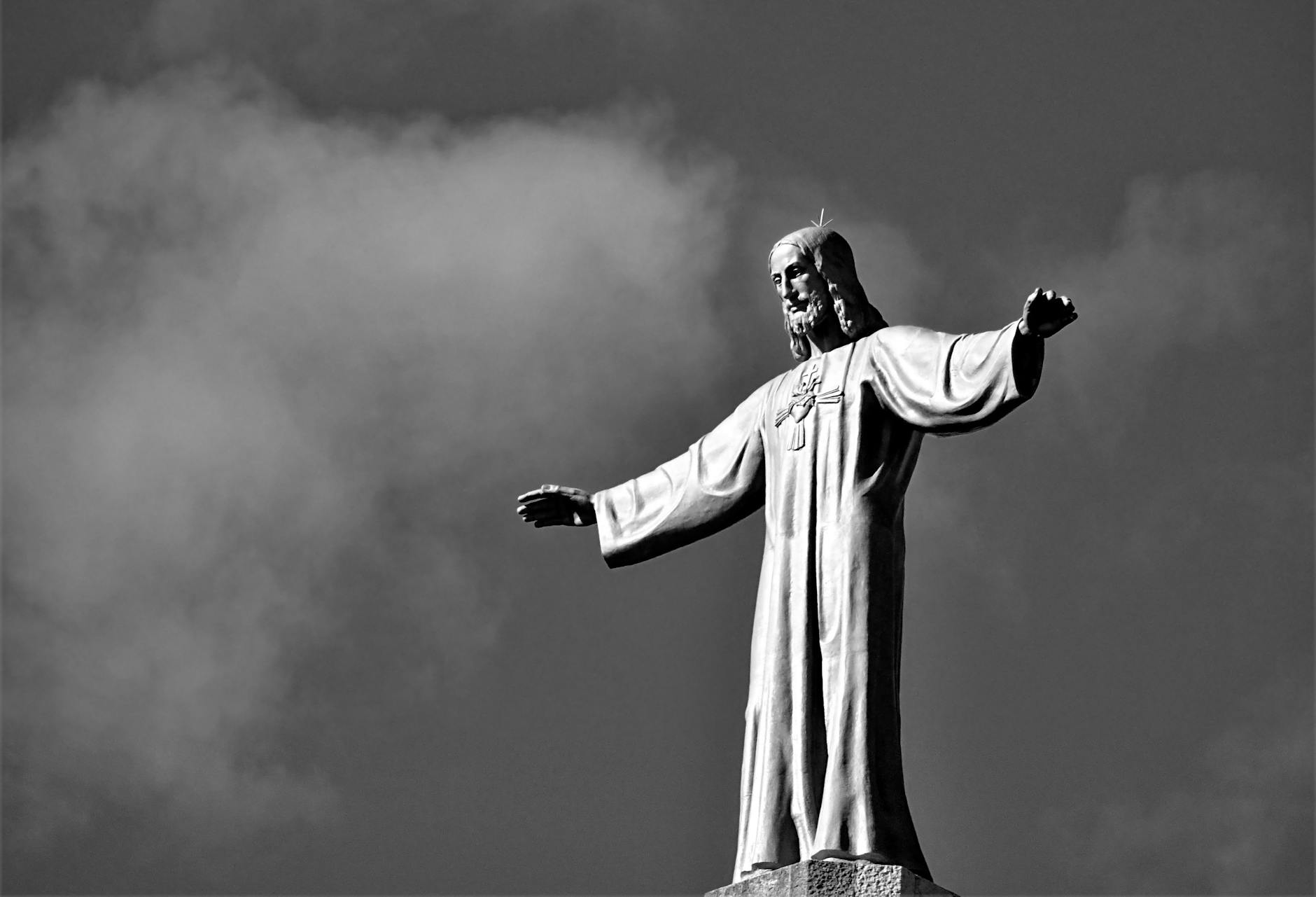
I grew up hearing about Jesus in church, like a lot of people. But the version I learned about was… sanitized. The Jesus I see now, the one I’m meeting again through Matthew, Mark, Luke, and John, the one I connect to in meditation and prayer, feels different. Like someone who walked through this world full of fire and love, not just to save us, but to wake us up.
This post isn’t about theology or doctrine. I’m not a Bible scholar. I’m just someone trying to untangle what’s real. And when I read the stories of Jesus now, I see a mystic. I see someone who carried God within him, and knew we did too. I see someone who didn’t come here to start a religion, but to show us how to connect, deeply and personally, with something bigger.
He Was Always Pointing Us Back to Love
There’s a line in Luke that resonated with me so deeply: “The kingdom of God is within you.” (Luke 17:21). I had never really heard this emphasized growing up. But reading it now, it feels central. Jesus wasn’t pointing to a place or a performance. He wasn’t laying out a bunch of requirements. He was telling us that what we’re looking for is already here. Inside. We just have to be willing to see it.
And if the kingdom is within me, that means the work is too. The relationship is personal. It’s not about doing things to earn approval, it’s about getting honest with yourself. Seeing what parts of you are aligned with love and truth, and what parts still carry fear or shame or hurt. Jesus didn’t ask people to come to him perfect. He asked them to come real.
When someone asked him what the greatest commandment was, he didn’t hesitate. “Thou shalt love the Lord thy God with all thy heart… the second is like unto it, Thou shalt love thy neighbour as thyself.” (Matthew 22:37–39). That last part, “as yourself,” stopped me. I don’t think we talk enough about how important self-love is in that equation. Because if you don’t love yourself, you’ll always be loving other people from a place of lack, or resentment, or performance. You’ll be chasing something instead of offering something.
I’m not talking about the “treat yourself” kind of self-love the world throws around. I’m talking about real self-love. The kind that comes from healing and says, “I see the ugliest parts of me and I’m not afraid to face them.” Because that’s the work, and that’s how we align with God. By looking inward with honesty, not shame. And as we love ourselves more deeply and truthfully, we start to radiate love more naturally toward others.
He Flipped Tables… and Expectations
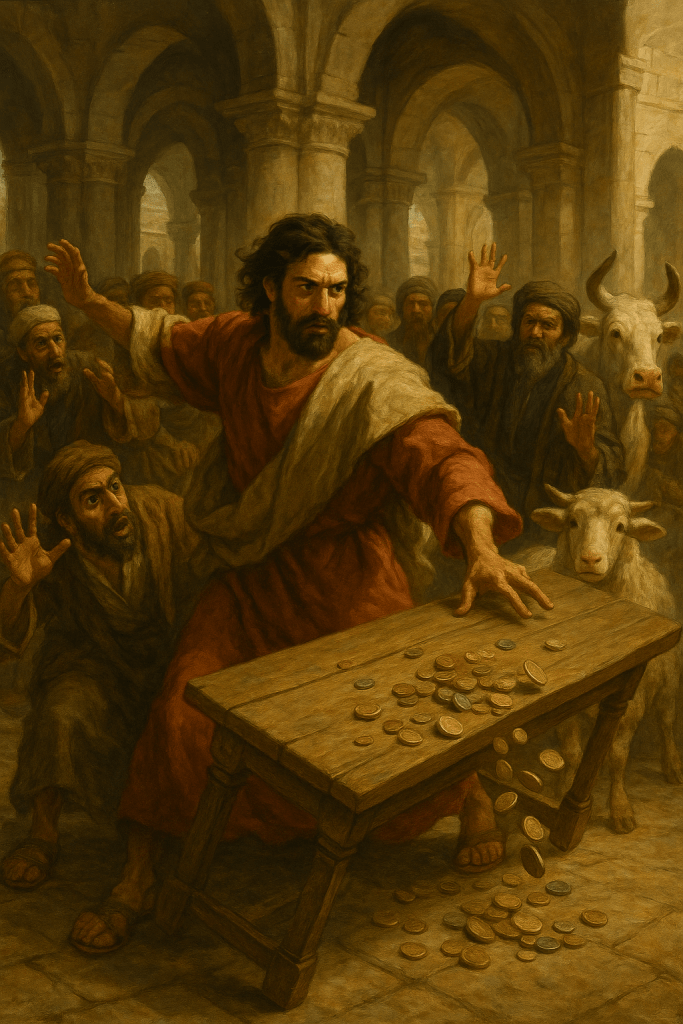
One of my favorite stories is when Jesus enters the temple in Jerusalem and flips the tables. In John’s version, it says he made a scourge of small cords and drove them all out of the temple, along with the sheep and oxen, then poured out the changers’ money and flipped over the tables. “Take these things hence; make not my Father’s house an house of merchandise.” (John 2:16). It’s such a powerful moment. Jesus wasn’t passive in his message here. He wasn’t afraid to disrupt the system or piss people off. He called out power and tradition when it was corrupt. Loudly, publicly, and without apology.
And he did this again and again. He stood with the people who were left out, overlooked, and judged. He spoke up for the poor, the sick, the women, and the outcasts. He had compassion for the struggling and very little patience for those pretending to be holy while protecting their own status. This part of him isn’t talked about enough. This is the part of him that feels so human, yet so powerful. Like he’s just one of us.
There’s another part in Matthew where he calls out the religious leaders and says, “You clean the outside of the cup and dish, but inside they are full of greed and self-indulgence.” (Matthew 23:25). If we’re honest, we’ve all done that. Tried to make things look fine on the outside while ignoring the mess on the inside. But Jesus didn’t care about appearances. He cared about the truth. And he didn’t shame people for their mess. He welcomed them in, sat with them, and healed them. But he was clear about one thing: don’t fake it.
That’s what I love about him. He didn’t ask for performance. He asked for alignment. He didn’t want perfection. He wanted people to come home to themselves, to come back to love. To let go of the guilt and the roles and the rules and to remember who they are.
Coming Home to Ourselves

Reading through the gospels with new eyes, I don’t see a man trying to build a church. I see someone saying, “You already have access to God. You just forgot.” He came to remind us. And he did it through love. Radical, uncomfortable, liberating love.
That’s the part I never really heard in church. Following God isn’t about going to church on Sundays just to say you did, or praying before every meal when you’ve never truly connected to the God you’re praying to. It’s about healing. It’s about seeing where we’ve been out of alignment and choosing to come back to the truth. That process doesn’t always look pretty. But it’s the most sacred thing we can do.
The more I sit with myself, get honest about what’s still hurting, and ask what still needs to be let go, the more I feel connected to God. Not as something far away, but as something I’m slowly remembering I was never separate from to begin with.
If you consider yourself a Christian, I want to ask you something. Have you truly felt the presence of God within you? Have you really walked with Jesus, not just through ritual or routine, but in your heart? Do you understand what he taught, and have you felt that unexplainable warmth when you finally connect with something bigger than yourself?
And if you’re not religious, or if you’ve been hurt by religion, or taught a version of Jesus that felt cold, judgmental, or distant, I invite you to take another look. Get curious about who Jesus really was and what he actually taught. Not the image you were handed, but the man who walked among the poor, flipped tables in the temple, and taught that the greatest thing we can ever do is love.
And now, after all this time, I can finally say I know him, and I’m so thankful for that.
With love & light,
Jessica ♡
 Unraveling the Self
Join the conversation